"The media’s interest in cyanide-laced Tylenol pills after all these years is giving me a headache. Call it 'poetry of witness' if you want, but you’re still a fink about me taking the last donut at the business meeting. "
Showing posts with label Mark Cunningham. Show all posts
Showing posts with label Mark Cunningham. Show all posts
17 August 2010
14 October 2009
Busloads of news: books, reviews, interviews, other & elsewhere
RE: OPEN READING PERIOD
Two weeks remain for submissions of full-length manuscripts to Tarpaulin Sky Press's open reading period. Details here.
* Now available for pre-order (ships Nov 1st):
Ana Božičević
Stars of the Night Commute
ISBN: 9780982541609
Poetry | 6"x8", 84 pp, pbk | Nov. 2009
$14 includes shipping in the US
Cover: Remedios Varo | Ícono, 1945 [Icon]
Óleo, incrustaciones de nácar y hojas de oro sobre tríptico de madera [Oil, mother-of-pearl and gold leaf inlays on a wooden tryptich] | 60 x 39,3 x 5,5 | Malba - Fundación Costantini, Buenos Aires | Reproduced with kind permission of Anna Alexandra Gruen.
Click here for more information. Click the PayPal logo to pre-order online:
Stars of the Night Commute haunts in three dimensions, knit by a below-words rumble in the sure rhythm of dreams. Many of the poems carry a shamanistic, elemental quality, as if real matter were articulating out of word-fragments. Božičević writes, "At the end of poetry the poem can no longer be remote." If this is "the end of poetry," perhaps poetry is, after all, reaching forward back to its beginning.
—Annie Finch
Ana Božičević's poetry has everything—a mastery of language, a distinct and singular voice and a worldview so visionary and all-encompassing, so as to both terrify and astound. The words bristle with life, and they command the deepest reverence for the Ineffable, for pure Being. This poetry is clever without being shallow, and this is truly rare. Silence is my most honest response to her work, but a silence rooted in respect and awe for that which is truly great art.
—Noelle Kocot
Ana Božičević's work is sort of animist—it’s either about silence or the racket of the world. How does she do it? Clicks the switch to say it’s silent & it’s happening then on a distant tiny stage. She’s muttering, and then it’s a story and a very good one. I mean in poetry at some point you don’t know what the writer means. In Ana’s work I watch “it” vanish (all the time) & I trust it.
—Eileen Myles
Ana Božičević's work is filled with a wild freedom, and reading it often reminds me of reading Wallace Stevens, in that you know absolutely anything can happen next but whatever it is, it will be perfect. In her poems she expresses an attitude of solemn responsibility to history, both the world's and her own, yet there is often a marvelous lightness, even playfulness about them. She is able to stretch language to its most ineffable and musical limits while maintaining a masterful grasp of the colloquial. These are not just technical matters. An émigré from reality (in the form of one of modern time's most monstrously and moronically cruel wars) and a Cassandra, she is able to perceive with the eyes of language—then render with lyrical immediacy—the experience of our collective sleepwalking soul, who may well soon awaken to discover that its terror was not a dream.
—Franz Wright
About Ana Božičević
Ana Božičević was born in Zagreb, Croatia in 1977. She emigrated to NYC in 1997. Stars of the Night Commute is her first book of poems. Her fifth chapbook, Depth Hoar, will be published by Cinematheque Press in 2010. With Amy King, Ana co-curates The Stain of Poetry reading series in Brooklyn, and is co-editing an anthology, The Urban Poetic, forthcoming from Factory School. She works at the Center for the Humanities of The Graduate Center, CUNY. For more, visit nightcommute.org.
* * *
 This is What a (Pro)Feminist [Man Poet] Looks Like
features an essay by TSky Press publisher Christian Peet. Peet's response includes three mini-essays on the work of past TSky Guest Editors Bhanu Kapil and Selah Saterstrom, as well as the work of Aase Berg.
In May 2009, Danielle Pafunda curated the first installment of Delirious Hem's "This is What a Feminist [Poet] Looks Like." This forum featured women discussing the relationship between their feminism & their poetry, and these contributions elicited thoughtful responses from women & men bloggers alike. Mark Wallace was one of those bloggers. Together, they've curated "This is What a (Pro)Feminist [Man Poet] Looks Like."
All this week, new essays are posted:
Monday October 5: Brian Teare, Christian Peet, & H.L. Hix
Tuesday October 6: Hugh Behm-Steinberg, Kareem Estefan,
& Kevin Simmonds
Wednesday October 7: Mark Wallace, Mike Hauser, & Nate Pritts
Thursday October 8: Philip Jenks, Tim Atkins, & Tony Frazer,
Friday October 9: Tony Trigilio, David Lau & Rodrigo Toscano
* * *
 In mudluscious #9, J.A. Tyler provides a kind & concise review (shoutout may be a better term?) re: Christian Peet's Big American Trip.
* * *
 Fence & Tarpaulin Sky Press author Joyelle McSweeney is interviewed as only Joyelle McSweeney can be interviewed, at Rob McClennan's blog.
Here's a taste:
When your writing gets stalled, where do you turn or return for (for lack of a better word!) inspiration?Go here for the rest.
I turn to South Bend. Really, until you have lived in a rotting rust belt town you have not lived. People are hurting here, and they are dogged and ingenious. They drive their trucks through the walls of their living rooms on a nightly basis. They get in fights and throw pregnant dogs at each other. They find remarkable items to pawn (one winter morning two middle aged people were standing outside one of the many pawn shops at 7 AM trying to hold a window airconditioning unit up out of the snow. They were wearing sweatsuits and no coats.). There are residential motels here, one is called the Wooden Indian and it has almost no interior. So it’s a shelter without any shelter. We have a lot of yard sales around here where everyone tries to sell used goods to everyone else. The same used goods just pass back and forth. Capitalism is played out and distended here and very visibly broken. As a pregnant woman and a mother with a toddler, I fit right in to most expectations about women in this place, at least until I open my mouth and reveal myself not to be a Hoosier. But most of the time, at the supermarket, the BMV, the playground, the IRS office, daycare, I do not open my mouth. One is not invited to do so. As Denis Johnson writes at the end of Jesus’ Son, “I had never known, never even imagined for a heartbeat, that there might be a place for people like us.”
* * *
 Sean Lovelace wins the TSky Press "Hells Yeah, Go Fondle Some Art" Award for most entertaining review of Andrew Zornoza's Where I Stay.
Here's a taste:
I would like to light my velvet pipe, stuff it with velvet tobacco, lean back, and say to you now that only sophistry could infer the “existence” of nonbeing. The nothingness which fascinates recent literary folks/analysts is a myth of declining capitalist society, and I should know. I got your tower ivory. The earth is black and buckled.
I finished the Andrew Zornoza book and it had me thinking. It was a small animal gnawing my shin, a teething, bloody type of thinking. I had class in five minutes and my head felt like the way men lay on a loading dock. You know how reading can be a cave (writing too, and Percodan). I didn’t know how I was going to use these feelings from Zornoza’s book in my class. I mean I wanted to do something.
So I took the class down to the BSU art museum and told them to touch something, to reach out and teach a piece of art, a painting or a sculpture. The BSU museum contains Warhol and Greek statues and Jesus bleeding all over lush crosses and all those museum necessities. The response was interesting . . .
* * *
 TSky Press author Mark Cunningham has been busy since publishing Body Language. Not one but three new chapbooks are available from Mark:
nightlightnight, a collaborative web chapbook, with photographs by Mel Nichols, hosted at Right Hand Pointing
&
Nachträglichkeit, an ebook (PDF file) from Beard of Bees
&
10 specimens, an ebook (PDF file) from Gold Wake Press

Alan Semerdjian's In the Architecture of Bone is now available from GenPop Books. Order directly from GenPop Books, get free shipping anywhere in the U.S., and save around $5 off what you'd pay at Amazon. Yeah, it's a sweet deal.
Click here for excerpts and more information. Click here to order
Alan Semerdjian's In the Architecture of Bone reads like a long poem cycle that pulls the reader into an open field in which Semerdjian weaves his explorations of language and art, Armenian history and family. These dynamic poems mingle the ghosts of the past with the pace of contemporary life. This talented, young poet is well worth your reading.—Peter Balakian
Writer/musician Alan Semerdjian’s poems and essays have appeared in several print and online publications and anthologies including Chain, The Lyric Review, Adbusters, Arson, Ararat, and Diagram. He released a chapbook of poems called “An Improvised Device” (Lock n Load Press) in 2005. His songs have appeared in television and film and charted on CMJ. Alan has performed and read all over North America. He currently teaches at Herricks High School in New Hyde Park, NY and resides in New York City’s East Village.
* * *
 Also, if you haven't checked out GenPop Books' online magazine, No Contest, now may be a good time to start. They've just posted new work by Alissa Nutting, whose first collection of short fictions, Unclean Jobs for Women and Girls, was picked by Ben Marcus for publication by Starcherone Books. Nutting kicks off October at New Contest with a story about "free sex" on the set of a children's television show, dancing in a mouse costume, and a little blond star named "Missy."
An excerpt from "Dancing Rat":
I’m haunted by how physically perfect Missy is, her clear skin and her white white teeth. She just landed a detergent commercial, and because I want to punish myself I will not be able to resist switching to that brand. I am a zombie-slave under Missy’s control, I often think. I don’t have a child and I probably will never have a child: I hate this but trying any harder to have one seems like it would make the reality sink in even more. It is far easier to just do the bratty things Missy asks me to do, buy her endorsed products, and act like this agonizing relationship somehow brings me closer to motherhood. . . .Go here for the rest.
Going back on set when I know I have semen inside of me reminds me of that urban myth about a chemical that will turn all the water around people purple if they pee in the pool. I kind of expect that one day, while walking across the Rainbow River Bridge over to the Sharing Seat, I will look down and realize my crotch is flashing like a police siren due to some product that detects seminal fluid on the sets of children’s shows.
* * *
NEW REVIEWS AT TARPAULIN SKY
some excerpts:
Albert Goldbarth's Griffin, reviewed by Katie Eberhart
[Griffin] explores the nature of truth, of illness, and relationships, deftly hooking together information and experience in a shape-shifting narrative that moves forward, reverses, follows surprising detours and tangents, settling for truth that resides in the complicated messiness somewhere between a carnival ride and a Carl Sagan lecture. The narratives tackle tricky topics like failing relationships, illness and mortality with the grace of a poet, the thoroughness of a historian (and student of “the contemporary”), sensitivity, and humor. . . .Chris Tonelli's No Theater, reviewed by Christopher Salerno
Masks here are also symbols of potential, often allowing the speaker the distance he needs to gain perspective on nature and the self: “Memories, / interior resonance, you / are inventing / new natures.” If a mask is a symbol of potential, it is one that, for Tonelli, certainly doesn’t muffle the voice. The masks of No Theater are a vehicle through which the character navigates emotional complexity, and the result is often personal and forthcoming: “The audience, / a constellation / scalding the silence. / They are waiting / for my feeling. I am waiting / to feel their absence." . . .Michelle Detorie's Ode to Industry, reviewed by Juliet Cook
Many of the poems in Ode to Industry also present certain domestic trappings within unlikely contexts, so that ordinarily innocuous or even utilitarian objects suddenly take on a tone of menace or veiled threat. Seemingly routine assembly line rhythms are juxtaposed with an underlying sense of unease that just might spring forth like the blades in a spring loaded tampon, hidden within until a moment of hideous impact. Flesh containers and domestic constraints intermingle and brush up against each other, sometimes coalescing; other times, repelling or resisting. . . .Blake Butler's Scorch Atlas, reviewed by J.A. Tyler
Scorch Atlas is a world of mold, a world of festering wounds, a world of hurt. Scorch Atlas is a carefully and meticulously distraught world of language, a trembled and shaken line of thought, a vibrant dead trance of phrasing, the measure of words put together all and in the right ways. Blake Butler has made something enormous here, in the reams of his Scorch Atlas, and if nothing else, we are simply destroyed by it, mistaking our skin for its cover, our blood for its damage, our eyes for its violent and broken images. . . .Alexis Orgera's Illuminatrix, reviewed by Mark Rockswold
Illuminatrix . . . questions the rigid boundaries between high and low art, the sciences and arts, and language’s conceptualizing work in general: “there are mighty critics, illuminators deft / in the art of finding meaning /where none should exist” (30). Therefore, in the midst of its own illuminating project, the collection asks, is illumination a good thing? What is lost in the process? To have illumination, there must inevitably be darkness—in this way paradox and equivocal possibility become Illuminatrix’s only sure reality. . . .
Skip Fox's For To, reviewed by Megan Burns
* * *Fox tells us early on: “Even the boy raised by wolves had a language” (15). He wavers between presenting language as quintessential to the human condition and also limiting and laughable in its design. In witty aphorisms and slingshot asides, Fox pokes fun at us, the users of language, who think we know what we’re talking about when we do talk. “Reason is one thing that happens” (61) . . .
More great news: ecopoetics 06/07 is now available, and comes highly recommended by TSky.
Edited by Jonathan Skinner, ecopoetics is "a (more or less) annual journal dedicated to exploring creative-critical edges between making (with an emphasis on writing) and ecology (the theory and praxis of deliberate earthlings)."
ecopoetics 06/07 2006-2009 is 324 pages of poetry, essays, fiction, translation, interviews: Emily Abendroth, Fatho Amoy, mIEKAL aND, Kristen Andersen, Karen Leona Anderson, Stan Apps, Robert Ashton, Mei-mei Berssenbrugge, Christine Boileau, Timothy Bradford, Pam Brown, Julieann Brownton, James Bunn, Andrew Burke, Bonny Cassidy, Louise Crisp, Justin Clemens, Jon Cone, Jack Collom, Matthew Cooperman, Gregory Day, Tyler Doherty, Thom Donovan, Rachel Blau DuPlessis, Theodore Enslin, John Estes, Kate Fagan, Michael Farrell, Alec Finlay, Lisa Fishman, Benjamin Friedlander, Forrest Gander, Jody Gladding, Liberty Heise, Krista Ingebretson, Jill Jones, Patrick Jones, Michael Kelleher, John Kinsella, Kyhl Lyndgaard, James Koller, José Martí, John McBain, Ray Meeks, Graeme Miles, Stuart Mills, Peter Minter, Luis-Aguilar Moreno, Derek Motion, Jesse Nissim, Alistair Noon, Lucas North, Antonio Ochoa, Peter O’Mara, Isabelle Pelissier, Carol Quinn, José Rabéarivelo, Daniel W. Rasmus, Joan Retallack, Sarah Rosenthal, Linda Russo, Kate Schapira, Andrew Schelling, Jared Schickling, Jonathan Skinner, Gary Snyder, Juliana Spahr, James Stuart, Alf Taylor, Angélica Tornero, Rodrigo Toscano, Lauren Tyers, Erica Van Horn, Stephen Vincent, Damian Weber, Simon West, Les Wicks
$17 Postage included; outside US & Canada, add $5
ecopoetics current and back issues are distributed by SPD and are also available directly from the publisher: Please make checks payable to Jonathan Skinner: ecopoetics ~ 145 Carding Machine Road _ Bowdoinham, ME ~ 04008
* * *
Edited by TSky faves Adam Clay and Matt Henriksen, Typo 13 features poems from TSky contributors Laynie Browne, Carolyn Guinzio, Lucy Ives, and Rauan Klassnik, along with a host of other greats: Cynthia Arrieu-King, Zach Barocas, Brooklyn Copeland, Christopher Deweese, Claire Donato, Kathryn Donohue, Joshua Harmon, Philip Jenks, Ben Mazer, Rachel Moritz, Sara Mumolo, Tom Orange, Anthony Robinson, Susan Scarlata, Nate Slawson, and Stephen Sturgeon.
* * *
We're new to Wag's Revue, and were pleased to discover that its new issue contains interviews with John D'Agata, Lee Gutkind, and George Saunders, as well as six H.C. Artmann poems translated by Rosmarie Waldrop, and Rimbaud translated by Christian Bök.
* * *
RECENTLY RECEIVED
Most of the titles below are available for review, though we include the friend copies and the purchased copies as well, thinking we can probably scare up another copy if you're interested in reviewing one for TSky. Titles marked with asterisks are hand-bound books or are otherwise special editions and are limited, if still available at all.
* Emily Abendroth, Toward Eadward Forward (Horseless Press, 2009)
* Sarah Bartlett and Chris Tonelli, A Mule-Shaped Cloud (Horseless Press, 2009)
James Belflower, Commuter (Instance Press, 2009)
Birkensnake #2
* Sommer Browning, Vale Tudo (Horseless Press, 2009)
Brigitte Byrd, Song of a Living Room (Ahsahta Press, 2009)
* Allison Carter, Shadows Are Weather (Horseless Press, 2009)
* Thomas Cook, Anemic Cinema (Horseless Press, 2009)
Denver Quarterly, Vol. 44, No. 1
Kate Durbin, The Ravenous Audience (Black Goat, 2009)
Elena Georgiou, Rhapsody of the Naked Immigrants (Harbor Mountain Press, 2009)
Kate Greenstreet, The Last 4 Things (Ahsahta Press, 2009)
Barbara Henning, Thirty Miles to Rosebud (BlazeVox Books, 2009)
* Alex Lemon, At Last Unfolding Congo (Horseless Press, 2009)
Michael Leong, e.s.p. (Silenced Press, 2009)
P-Queue, Vol. 6
* Andrea Rexilius, To Be Human Is To Be A Conversation (Horseless Press, 2009)
Alan Semerdjian, In the Architecture of Bone (GenPop Books, 2009)
Jered Schickling, O (BlazeVox Books, 2009)
Zachary Schomburg, Scary, No Scary (Black Ocean, 2009)
Jason Whitmarsh, Tomorrow's Living Room (Utah State University Press, 2009)
16 March 2009
Notes for 16 March 09
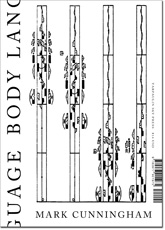
2. Cynthia Reeser reviews Mark Cunningham's "beautifully designed" (thank you, Ms. Reeser) Body Language and interviews Mark (wherein he discloses what we've always suspected: "the book as a whole has for its ideal readers curious children and space aliens") at Prick of the Spindle.
3. Craig Santos Perez reviews Jenny Boully's one love affair at Rattle.
5. And TSky has posted new reviews as well:
a. Sidebrow#2 reviewed by AD Jameson6. Justin Mark's new chapbook, Voir Dire, is now available from Rope-a-Dope Press. Letterpressed in an edition of 96, one would be hardpressed to spend $8--which includes shipping--more wisely.
b. Denise Newman's Wild Goods, reviewed by Aidan Thompson
c. Anne Blonstein's memory's morning, reviewed by Kathrin Schaeppi
d. Dmitry Golynko's As It Turns Out, reviewed by Eireene Nealand
7. Shampoo Issue 35 features a section of poetry from Germany (in German with English translations) brought to you by Guest Editors Ron Winkler and Christian Lux, as well as a special section from Guest Editor Ronald Palmer. Poets & translators include Stephanie Young, Uljana Wolf, Jan Wagner, David Trinidad, Thien Tran, Barbara Thimm, Mark Terrill, Brian Teare, Gary Sullivan, Ramsey Scott, Tom Schulz, Katharina Schultens, Sabine Scho, JD Schneider, Ulrike Almut Sandig, Andre Rudolph, Jan Volker Röhnert, Lawrence Rinder, Nikola Richter, Kevin Prufer, Georgina Paul, Ethan Paquin, Danielle Pafunda, Peter Nickowitz, Daniel Nester, Steph Morris, Sara Larsen, Norbert Lange, Wayne Koestenbaum, Kevin Killian, Ernst Herbeck, Duriel E. Harris, Catherine Hales, Matthias Goeritz, Jane Gibian, Iain Galbraith, Johannes CS Frank, Michael Farrell, Daniel Falb, Carl Christian Elze, Peter Covino, Ann Cotten, CAConrad, Jenny Boully, Jennifer Blowdryer, Nico Bleutge, Mark Bibbins, Susan Bernofsky, Dodie Bellamy, Toby Axelrod & Shane Allison, with scratch&sniff ShampooArt by Otto Chan. Edited by Del Ray Cross.
16 November 2008
Now Available: Mark Cunningham's _Body Language_
 Mark Cunningham
Body Language
ISBN: 9780977901975
Prose Poetry. 5"x7", 136 pages
Perfectbound, tête-bêche
- Click here for more info
- Order here ($14 includes shipping in the US)
Two full-length collections of prose poems contained in Body Language, one titled Body (on parts of the body) and one titled Primer (on numbers and letters), together form a diptych investigating the body in language and language in the body.
Advance Praise for Body Language
In Mark Cunningham’s asymptotic collection, two discreet texts, Body and Primer, form a provocative, loopic continuum in which prose poems “defining” body parts (The Spleen, The Pituitary Gland, The Pimple, The Thumb) mesh with an abecedarium/cipher concerning topics as various as fate, reality, and phenomenology. With its trope of clue-like instruction and unique, flip-book embodiment, Cunningham‘s book creates a kind of hybrid detective f(r)iction, an intrepid mash-up of high and low cultures in which the reader is as likely to encounter Rilke and Proto-Sinaitic inscription as Lacan, Film Noir, The Three Stooges, cell phones, higher mathematics, binary thought, and Coyote and Road Runner cartoons. Cunningham pitches with surprising clarity the most abstract meditations (“The sperm cell is the first zero. The vagina the second. Wait—before you floated in the placenta (the third), your mother floated and your father floated in theirs, and before them their others and their fathers . . . . You get dizzy, as in that moment in Citizen Kane when Kane pauses after leaving his wife’s bedroom and image after image recedes in mirror reflecting mirror. Another thing about DNA: if space curves, so does time,” for example, from “O as a Beginning”), offering in almost reportorial style a (d)evolutionary mix of anachronistic, equally relentless somatic and figurative explorations of the body (“a paradise of sorts”) and the mind. Northrop Frye called a riddle “essentially a charm in reverse . . . the revolt of the intelligence against the hypnotic power of commanding words.” Cunningham’s work moves in this direction; as Frye would put it, “Poem and object are very quizzically related: there seems to be some riddle behind all riddles which we have not yet guessed.” These poems are not the mere game-playing of an extraordinarily gifted and restless intellect; stalked by pain, fear, guilt, and the burden of awareness,, they can also be tender, betraying a capacity for happiness: “I rarely talk about myself, but I’ll tell you this: one of the best days I’ve had was when I passed a cinema and decided right then to see The Cameraman. Another time, I switched restaurants at the last minute, and met an acquaintance there, and ate with her, and three years later we’re still going out.” As obsessed as they are with the ironies and processes of mind and body, the poet’s concern is ever with the mysteries this human armature holds up: “life itself.”
—Lisa Russ Spaar, author of Satin Cash and Blue Venus, and editor of Acquainted with the Night and All That Mighty Heart: London Poems.
About Mark Cunningham
Mark Cunningham lives in central Missouri. He is the author of 80 Beetles (Otoliths, 2008) and two chapbooks from Right Hand Pointing, Second Story and the forthcoming nightlightnight.
Excerpts from Body Language
* from Primer, "G"
* from Primer, "O as a Beginning," "A," "M," and "X"
26 March 2008
In Posse #24
 Guest edited by Richard Garcia and TSky's own Julianna Spallholz, the 24th issue of In Posse Review features a host of TSky folks: publisher Christian Peet, press authors Jenny Boully, Mark Cunningham, and G.C. Waldrep; and journal contributors Annie Guthrie, Tom O'Connell, and Cody Walker. Spallholz's section is a refreshing experiment in curating and co-creating. Spallholz conceived a "Prose Poetry Chain Story," in which she invited "a small collection of writers from our big community to speak to each other through pieces of original prose poetry, passed along like whispered messages in a child's game of Telephone." The project "started with a word that was known only by Kristen Nelson, the writer who began the chain. Kristen composed a piece with this word in mind and passed the piece on to the next three writers in line, who then composed a piece in response to Kristen's piece and passed it on to the next writers, who composed and passed on to the next and final writers."
Other writers in the chain include Dana Elkun and Johnny Horton. The rest of the issue, "Prose Poems Straight Up," includes work by Nin Andrews and Peter Conners, Tony Barnstole, Jeanne Marie Beaumont, Barbara Berg,Rick Bursky,Robin Clarke, Wyn Cooper, John Estes, Christine Hamm, Peter Johnson, Christopher Kennedy, Andrew Neuendorf, Alexis Orgera, Eugenia Hepworth Petty, Jason Stumpf, Thom Ward, Charles Harper Webb, Orlando White, and Katherine Williams.
Subscribe to:
Posts (Atom)


